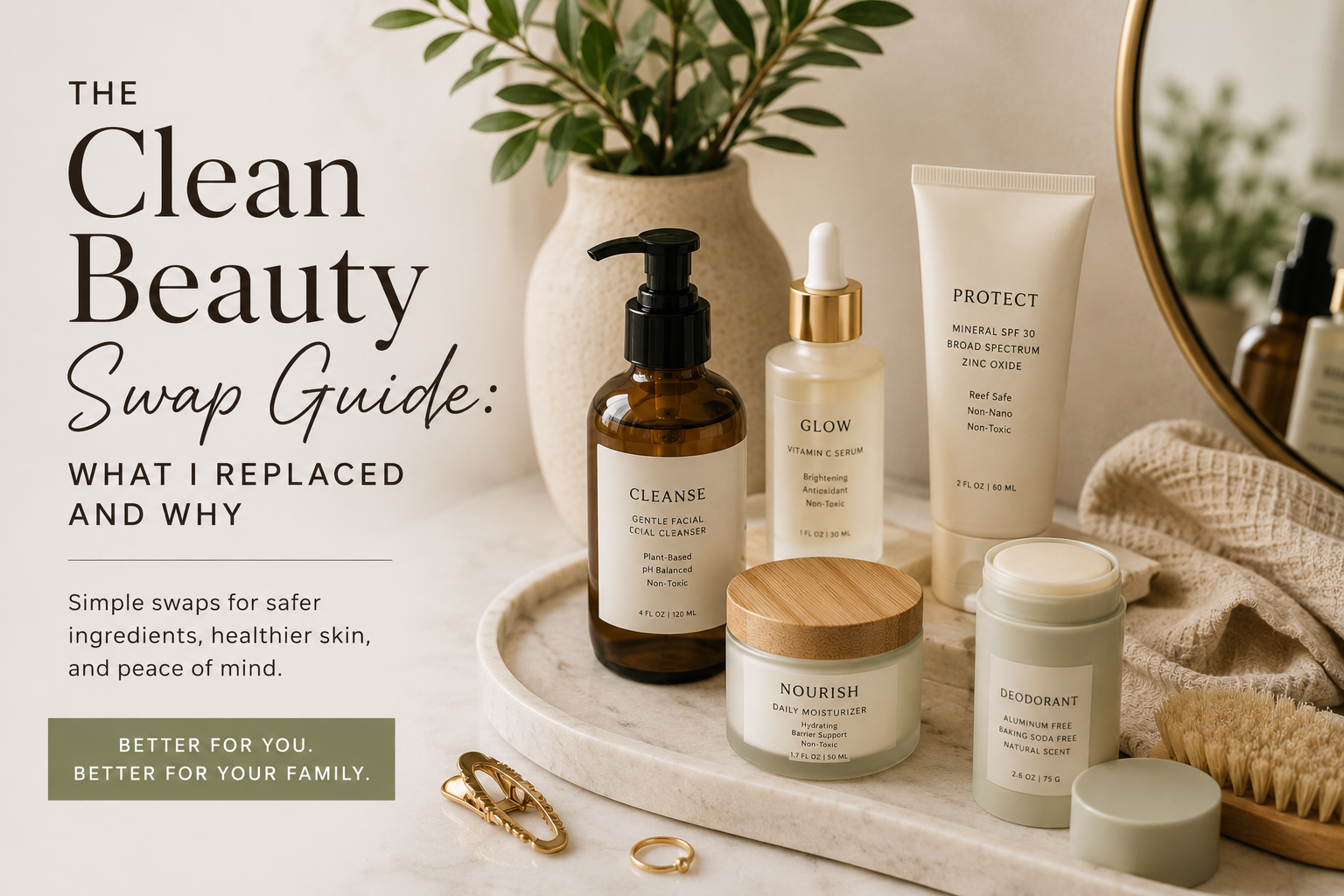
I was the last person in my friend group to make clean beauty swaps.
Partly because I’d finally found a skincare routine that worked for my skin. A moisturizer that didn’t break me out. A mascara that actually held a curl. I’d spent years and too much money finding these products and I wasn’t willing to give them up for something that might not work.
Partly because every clean beauty brand I tried felt like a compromise. The foundation oxidized. The deodorant failed by noon. The mascara flaked. I tried three different “natural” face washes that left my skin feeling like sandpaper.
Then I became a mom and my motivation shifted.
I started reading ingredient labels the way I’d been reading food labels for years. What I found wasn’t great. Parabens. Phthalates. Synthetic fragrance — listed simply as “fragrance” on the label, a word that can legally hide hundreds of undisclosed chemicals. Oxybenzone in my SPF. Formaldehyde-releasing preservatives in my shampoo.
Your skin is your largest organ. It absorbs up to 60% of what you put on it directly into your bloodstream. The products I was using every single day — multiple times a day — were delivering a steady stream of chemicals I wouldn’t have chosen if I’d known they were there.
So I started switching. Slowly, category by category, replacing products as they ran out.
What I found surprised me: the clean beauty category has genuinely transformed. The products I use now aren’t compromises. Several of them outperform the conventional versions I spent years being loyal to.
Here’s everything I switched, why I switched it, and what I use now.
This post contains affiliate links. I only recommend products I personally use or would use in my own home.
What to Look For — and What to Avoid
These are the ingredients to avoid when making clean beauty swaps:
Avoid these:
- Parabens (methylparaben, propylparaben, butylparaben) — synthetic preservatives linked to hormone disruption
- Phthalates — often hidden under “fragrance” — linked to endocrine disruption
- Synthetic fragrance (listed as “fragrance” or “parfum”) — can contain hundreds of undisclosed chemicals
- Oxybenzone — chemical UV filter linked to hormone disruption, found in most conventional SPF
- Formaldehyde-releasing preservatives (DMDM hydantoin, quaternium-15) — known carcinogens
- SLS/SLES (sodium lauryl sulfate) — harsh surfactants that disrupt skin barrier
- Mineral oil — petroleum byproduct that clogs pores
Keep this list in your phone for reference when you’re shopping.
Clean Beauty Swaps: Skincare
Cleanser
Most conventional cleansers contain SLS, synthetic fragrance, and preservatives that strip the skin’s natural barrier. I switched to a gentle, plant-based cleanser that actually improved my skin’s texture within two weeks.
→ OSEA Ocean Cleanser ← primary recommendation
Looking for a more budget-friendly starting point? This fragrance-free option is widely available and dermatologist recommended.
→ Cetaphil Gentle Skin Cleanser ← secondary recommendation
What to look for: Fragrance-free or naturally scented with essential oils, free from SLS and parabens, pH balanced.
Moisturizer
This was the swap I was most nervous about — I’d been using the same moisturizer for years. But the one I switched to absorbed faster, didn’t pill under makeup, and my skin genuinely looked better within a month.
→ Versed Moisture Maker ← everyday pick
For a more luxurious option that feels like a genuine skincare upgrade:
→ Tatcha The Water Cream ← premium pick
What to look for: Free from synthetic fragrance and parabens, ideally with naturally-derived actives like hyaluronic acid, niacinamide, or plant oils.
SPF — The Most Important Swap on This List
I want to spend a moment on SPF because this one matters more than most people realize.
Conventional chemical sunscreens — the kind most of us grew up using — rely on filters like oxybenzone, octinoxate, and avobenzone to absorb UV rays. These chemicals are absorbed through the skin into the bloodstream. The FDA has found that several chemical UV filters appear in blood at levels that exceed what they consider safe — and oxybenzone in particular has been linked to hormone disruption.
Mineral sunscreen — using zinc oxide or titanium dioxide — works differently. Instead of absorbing into the skin, it sits on top and physically reflects UV rays. It’s the option I use on myself and my family.
My daily SPF. No white cast, no greasy finish — this was the clean swap that took me longest to find and I’m genuinely loyal to it now.
→ Babo Botanicals Sheer Mineral Sunscreen Lotion SPF 50 ← face pick
For full body coverage — important for kids especially.
→ Badger Sport Mineral Sunscreen SPF 30 ← body pick
What to look for: Zinc oxide or titanium dioxide as the active ingredient. Avoid oxybenzone, octinoxate, and avobenzone.
Eye Cream
The skin around your eyes is the thinnest on your face — which means it absorbs everything you put on it faster than anywhere else. Switching to a fragrance-free, clean-formulated eye cream is one of the simplest upgrades you can make to your skincare routine.
Serum
This is where clean beauty has genuinely impressed me most. The clean serums I’ve tried in the last two years have outperformed their conventional counterparts — particularly for vitamin C and hyaluronic acid formulations.
→ TruSkin Vitamin C Serum → The Ordinary Hyaluronic Acid
Clean Beauty Swaps: Body Care
The clean beauty swaps that made the biggest difference in my daily routine started in the bathroom.
Body Lotion
Most conventional body lotions are loaded with synthetic fragrance — one of the most common skin allergens and a significant source of phthalate exposure. I switched to an unscented or naturally scented option and my chronically dry skin actually improved.
What to look for: Free from synthetic fragrance, mineral oil, and parabens. Naturally-derived moisturizers like shea butter, jojoba oil, or aloe.
Deodorant — The Swap Everyone Asks About
Let me be honest with you: this one took me three tries to get right.
The first two clean deodorants I tried didn’t work well enough for my lifestyle. So I’m only going to recommend the one that actually works — because I know this is the swap most people are most skeptical about.
What I look for: Free from aluminum, synthetic fragrance, and parabens. I’ve found that magnesium-based formulas tend to work better than baking soda based ones for sensitive skin.
A note on aluminum: conventional antiperspirants use aluminum salts to block sweat ducts. While the research on aluminum and health is still developing, many health practitioners recommend minimizing aluminum exposure — particularly for products applied near lymph nodes daily.
Body Wash
What to look for: Free from SLS, synthetic fragrance, and parabens. Plant-derived cleansers are gentler on skin and the microbiome.
Shampoo and Conditioner
Conventional shampoos are some of the most chemical-laden products in the average bathroom. SLS strips the scalp’s natural oils, synthetic fragrance sits on the hair and scalp all day, and many formulas contain formaldehyde-releasing preservatives.
→ INNERSENSE Organic Beauty – Natural Hydrating Hairbath Shampoo → Natural Sweet Spirit Leave-In Conditioner
A note on the transition period: if you switch from conventional to clean shampoo, your hair may go through a 2-4 week adjustment period as your scalp recalibrates its oil production. This is normal and temporary.
Clean Beauty Swaps: Makeup
Foundation
Clean foundation is where the category has made the most dramatic improvements in the last few years. The options available now offer real coverage, real longevity, and real performance.
→ILIA – True Skin Serum Foundation
What to look for: Free from synthetic fragrance, parabens, and talc. Many clean foundations now use naturally-derived pigments.
Mascara
This was my most stubborn swap. I’d been using the same conventional mascara for years because I hadn’t found a clean version that held a curl without flaking.
I finally found one.
→ILIA – Limitless Lash Mascara
What to look for: Free from parabens and synthetic fragrance. Ideally with a clean brush — conventional mascara wands can harbor bacteria.
Lip Color
Your lips are one of the areas where product absorption is highest — and where we accidentally ingest what we apply. Conventional lipsticks have been found to contain heavy metals including lead, cadmium, and chromium.
→ILIA – Color Block Lipstick →ILIA Balmy Tint Hydrating Lip Balm
The One Thing That Made Clean Beauty Swaps Easier
Before I found specific products I loved, the single thing that made the biggest difference in my clean beauty transition was learning to read ingredient labels.
Once I knew what to look for — and what to avoid — I could evaluate any product in about 30 seconds. The avoid list I shared at the top of this post is where I’d start.
The Environmental Working Group’s Skin Deep database (ewg.org/skindeep) is also a helpful resource for looking up specific products and ingredients.
Where to Start With Clean Beauty Swaps
f you’re not sure which clean beauty swaps to make first, remember that you don’t need to replace everything at once.
If I had to pick three swaps to make first based on daily exposure and absorption rate:
- SPF — you wear it every day, it covers your whole face, and chemical filters are absorbed into the bloodstream
- Deodorant — applied daily near lymph nodes, conventional formulas contain aluminum and synthetic fragrance
- Body lotion — applied over a large surface area, absorbed quickly, and most conventional formulas are loaded with synthetic fragrance
Everything else can follow at your own pace as products run out.
Ready to Go Deeper?
The Non-Toxic Home Blueprint includes a complete guide to clean beauty swapsalongside room-by-room guides for every space in your home — the same level of detail you found here, applied to your entire living space.
→Get the Non-Toxic Home Blueprint
And if you want a quick-start checklist for the highest-priority swaps across your whole home — not just beauty — grab the free Clean Home Starter Kit.
→Download the Free Clean Home Starter Kit
Why These Clean Beauty Swaps Are Worth It
The clean beauty swaps in this post aren’t about perfection. They’re about reducing your daily chemical exposure in the places where it’s easiest to start — and replacing products you were already buying with ones that work just as well or better. That’s it.
Have a clean beauty swap you love that I haven’t mentioned? Leave it in the comments — I’m always looking for new recommendations to test.
— Anna, Linen & Luster
This post contains affiliate links. If you purchase through my links I may earn a small commission at no extra cost to you. I only recommend products I personally use or would use in my own home.
