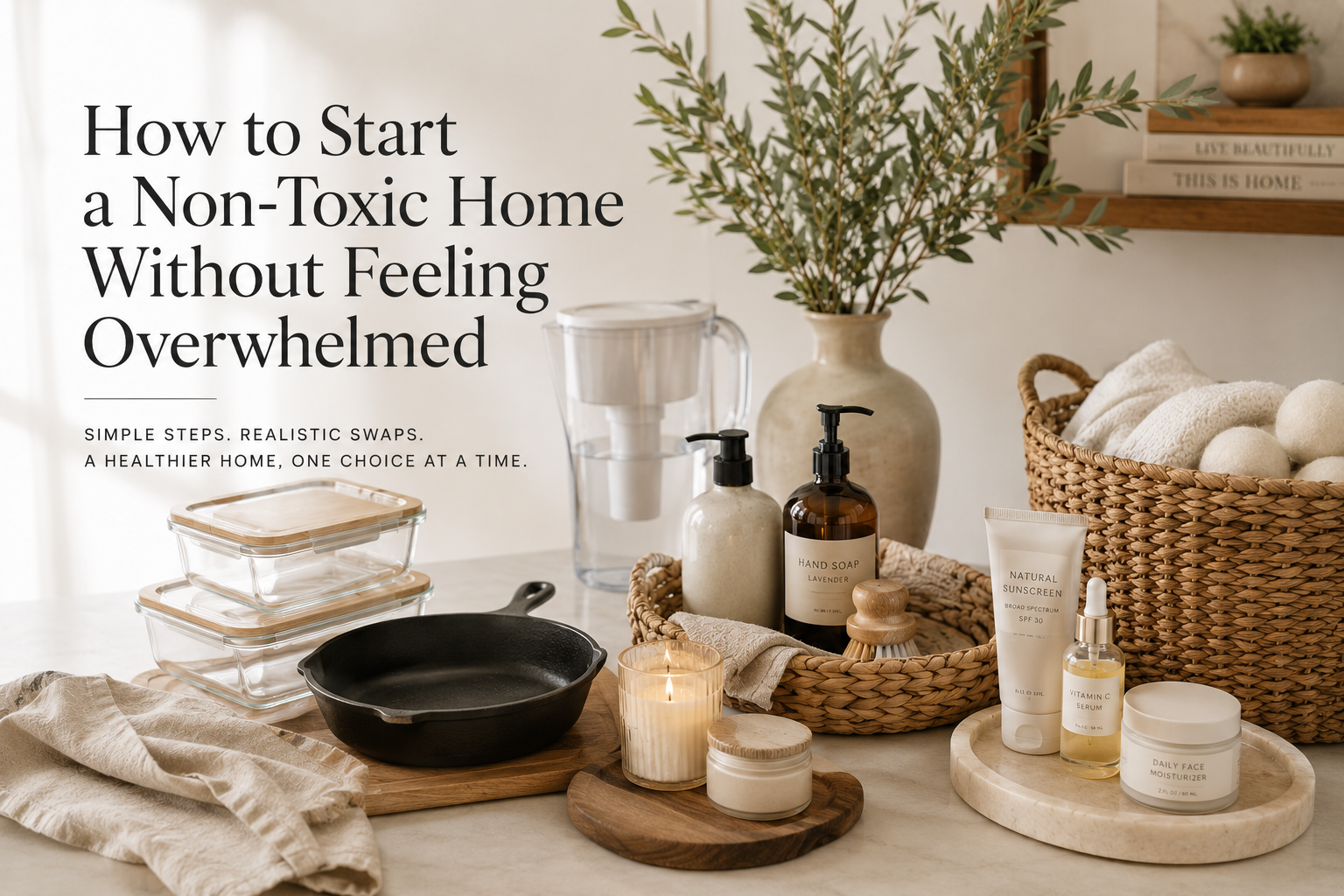
If you’ve ever typed “non-toxic home” into a search bar and immediately felt your heart rate increase — this post is for you.
Because the non-toxic living space online can feel deeply overwhelming. For example, every scroll reveals another product you’re supposedly poisoning your family with. Another ingredient to memorize. A whole category to overhaul. And another expensive swap to make immediately or your health is at risk.
It’s a lot. And most of it is fear-based, which is not how I want to approach this.
Here’s what I wish someone had told me when I started:
You don’t have to do everything at once. You don’t have to spend a fortune. And you don’t have to be perfect.
Creating a non-toxic home is a process — one that happens gradually, intentionally, and at a pace that works for your real life. I’ve been on this journey for a while now, and our home is genuinely healthier than it used to be. However, I didn’t get here overnight and I didn’t do it all at once.
Here’s exactly how I approach it — and how I’d recommend you start.
This post contains affiliate links. I only recommend products I personally use or would use in my own home.
The Mindset Shift That Changes Everything
Before we talk about specific swaps, I want to offer a reframe that made this whole journey feel manageable for me:
Don’t think about replacing everything. Think about improving over time.
After all, every conventional product that gets replaced with a cleaner option is a win — regardless of how many products remain unchanged. Progress over perfection, always.
In fact, the goal isn’t a perfectly non-toxic home by next Tuesday. The goal is a home that gets a little cleaner every month, every year, as products run out and get replaced with better options.
This reframe takes the pressure off completely. You’re not failing if you still have a bottle of conventional shampoo under the sink. You’re winning every time you choose something better when it runs out.
Start Here: The Priority Framework
Not all swaps are created equal. Some products represent a much higher exposure risk than others — based on how often you use them, how much skin contact they have, and how readily their ingredients are absorbed.
Here’s how I think about prioritization:
Highest Priority — Daily, High Absorption Products:
- Skincare (moisturizer, SPF, cleanser)
- Deodorant
- Body lotion
- Drinking water
High Priority — Daily Use, Significant Exposure:
- Cookware
- Food storage
- Dish soap
- Laundry detergent
- Shampoo and conditioner
Medium Priority — Regular Use, Moderate Exposure:
- All-purpose cleaning products
- Candles and air fresheners
- Bathroom cleaners
- Bedding and textiles
Lower Priority — Less Frequent Use:
- Occasional cleaning products
- Decorative items
- Furniture (replace as needed over time)
Start at the top of this list and work your way down. You’ll be making the highest-impact changes first while giving yourself permission to get to everything else in time.
Room by Room: How to Build Your Non-Toxic Home
The Kitchen: Your Non-Toxic Home Starting Point
If I had to choose one room to tackle first it would always be the kitchen — and here’s why.
The kitchen is where your family’s highest daily chemical exposure happens. The cookware you use every day. The water you drink and cook with. The food storage containers you microwave. The cleaning products you use on surfaces your food touches.
The good news is that kitchen swaps tend to last a very long time — a good cast iron pan or set of glass containers can last decades — so the upfront investment pays off over years.
Start with these three kitchen swaps:
1. Replace your non-stick pans
Conventional non-stick coatings (PTFE/Teflon) release toxic fumes when overheated. Replace with cast iron or stainless steel.
→ Lodge Cast Iron Skillet → Made In Cookware Stainless Steel Set
2. Filter your drinking water
Tap water contains chlorine, heavy metals, and increasingly PFAS (forever chemicals). A quality water filter is one of the highest-impact investments you can make.
3. Replace plastic food storage with glass
Plastic containers leach chemicals into food — especially when heated. Glass containers are safer, more durable, and look beautiful.
→ Glasslock Sens Glass Food Storage Set
The Bathroom Second
The bathroom is where most of us apply 10-15 personal care products every single day — and most conventional personal care products are loaded with synthetic fragrance, parabens, and other ingredients worth avoiding.
The key is to replace products as they run out rather than throwing everything away at once. Every time a product is finished, replace it with a cleaner version.
Start with these three bathroom swaps:
1. Switch to mineral SPF
Chemical sunscreen filters like oxybenzone are absorbed into the bloodstream. Mineral SPF with zinc oxide sits on the skin and physically blocks UV rays.
→ Badger Mineral SPF Sunscreen
2. Replace your deodorant
Conventional antiperspirants contain aluminum salts applied daily near lymph nodes. Clean deodorant that actually works exists — it just takes finding the right formula for your body.
3. Swap your body lotion
Applied over a large surface area and absorbed quickly — body lotion is one of the highest-exposure products in the bathroom. Most conventional formulas are loaded with synthetic fragrance.
The Laundry Room: An Overlooked Non-Toxic Home Priority
Laundry products are a surprisingly significant source of chemical exposure — your clothes and bedding are in contact with your skin for hours every day, and whatever residue your detergent leaves behind goes with them.
Synthetic fragrance in laundry products is one of the most common sources of phthalate exposure in the home. And dryer sheets are essentially synthetic fragrance delivery systems with no real cleaning function.
Start with these two laundry swaps:
1. Switch to a non-toxic laundry detergent
→ Branch Basics Laundry Detergent
2. Replace dryer sheets with wool dryer balls
Reusable, fragrance-free, and they actually work better than dryer sheets for reducing static and softening fabric.
→ Handy Laundry Wool Dryer Balls
The Living Areas — Go Slow Here
Living areas — sofas, rugs, curtains, paint — represent a longer-term project. These items are expensive and don’t need to be replaced urgently.
The two highest-impact things you can do in living areas right now without replacing any furniture:
1. Improve your air quality
Indoor air can be 2-5x more polluted than outdoor air according to the EPA. An air purifier with a HEPA filter makes a meaningful difference.
→ LEVOIT Air Purifier for Home
2. Replace your candles
Conventional paraffin candles release VOCs and synthetic fragrance when burned. Beeswax or clean soy candles are a simple, beautiful swap.
→ Bluecorn Beeswax Pillar Candle
The “As It Runs Out” Method
This is the approach I recommend to everyone who asks me where to start.
Simply put, don’t throw anything away. Just replace it with something better when it runs out.
Every time a product finishes — a bottle of shampoo, a container of cleaning wipes, a tube of moisturizer — pause before automatically repurchasing the same thing. Look up a cleaner alternative and buy that instead.
Over the course of a year, using this method, most of the highest-exposure products in your home will naturally cycle out and be replaced with better options. You’ll spend no more than you normally would on these products. And you’ll never feel overwhelmed because you’re only ever making one swap at a time.
The Products That Are Worth Spending More On
Clean living doesn’t have to be expensive — but there are a few areas where a higher upfront investment genuinely pays off over time:
Worth spending more on:
- Cookware — a quality cast iron pan or stainless steel set lasts decades
- Water filtration — the long-term health benefit justifies the cost
- Air purifier — runs continuously and represents ongoing exposure reduction
- Glass food storage — replaces dozens of plastic containers over time
Where to save:
- Cleaning products — many non-toxic options are competitively priced or cheaper than conventional
- Personal care — the clean beauty market has become very competitive on price
- Laundry — wool dryer balls replace dryer sheets permanently and pay for themselves quickly
What About Greenwashing?
Specifically, greenwashing refers to when brands use vague terms like “natural,” “green,” “eco-friendly,” or “clean” without any real ingredient transparency — and it’s rampant in this space.
The word “natural” on a label means nothing legally. “Free from parabens” can still contain phthalates. “Eco-friendly” says nothing about what’s inside the bottle.
Here’s how to cut through greenwashing:
- Read the full ingredient list — not just the front label claims
- Use the Environmental Working Group’s Skin Deep database for personal care products
- Look for specific certifications: EWG Verified, MADE SAFE, NSF certified
- When in doubt — fewer ingredients is usually better
Ready to Take Your Non-Toxic Home Further?
If you want to go beyond the basics and create a truly non-toxic home — room by room, category by category — the Non-Toxic Home Blueprint is the most comprehensive guide I’ve created. In addition, it covers every room in your home with the same level of practical detail you found in this post — plus product recommendations, ingredient guides, and a step-by-step implementation plan that makes the whole process feel completely manageable.
→ Get the Non-Toxic Home Blueprint
Where are you on your non-toxic home journey? Are you just starting out or have you been at this for a while? I’d love to hear in the comments.
— Anna, Linen & Luster
This post contains affiliate links. If you purchase through my links I may earn a small commission at no extra cost to you. I only recommend products I personally use or would use in my own home.
