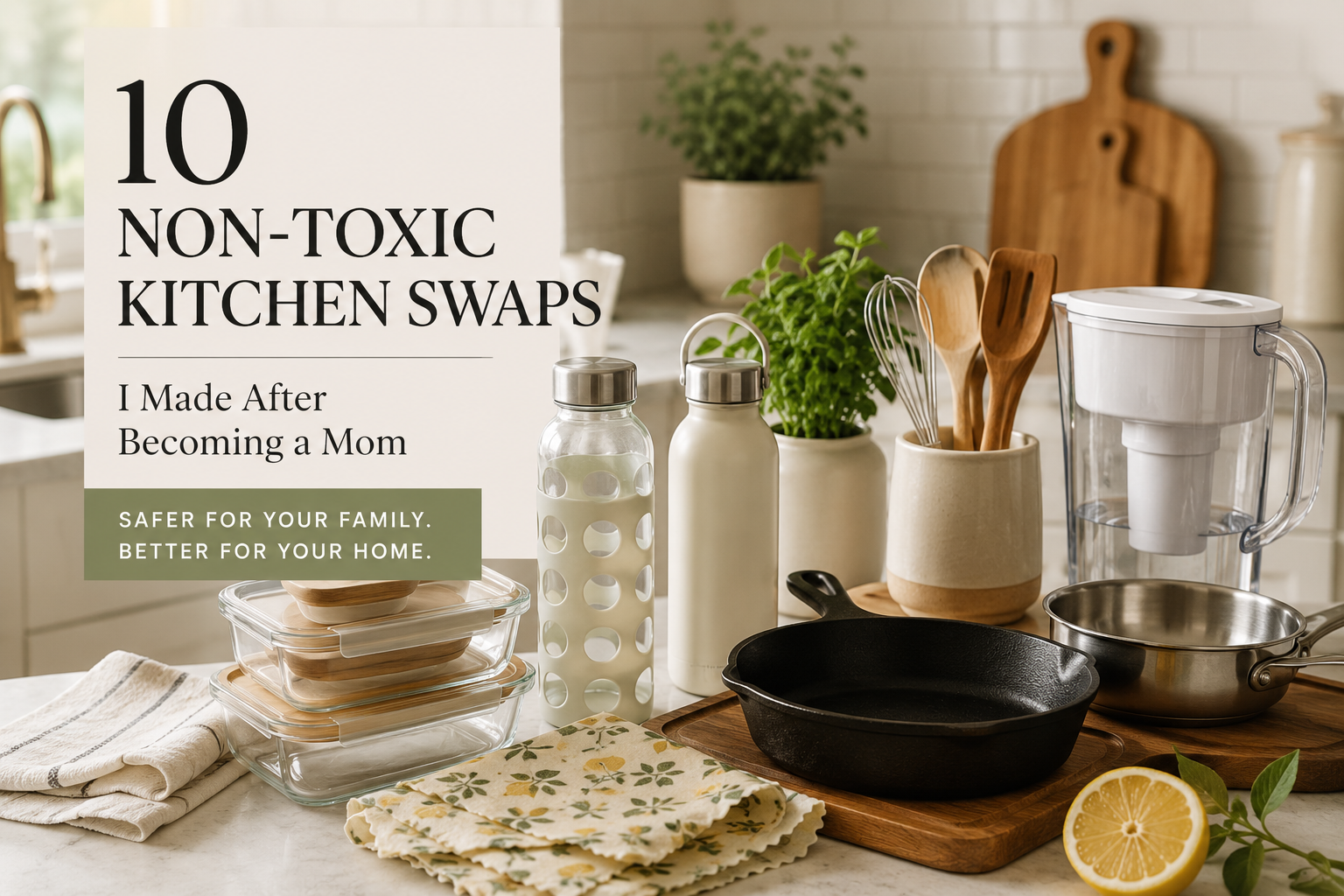
The kitchen was the last place I expected to find toxins — and non-toxic kitchen swaps were the last thing I thought I’d be researching.
Before becoming a mom, I was already buying organic produce, cooking most of our meals at home. I thought we were doing pretty well.
Everything changed, however, when I became a mom.
Something shifts when you hold your baby for the first time. Suddenly, you start looking at your home differently — the candles, the cleaning products, the pots and pans. I started researching, and what I found about my own kitchen genuinely surprised me.
For instance, the cookware I’d been using for years. The plastic containers I was microwaving. The water coming out of our tap. Surprisingly, none of it was as safe as I’d assumed.
Fortunately, the swaps are simpler than you’d think. Most of them are available right on Amazon. In fact, almost every single one looks more beautiful in my kitchen than what it replaced.
Here are the 10 non-toxic kitchen swaps I made — in the order I made them.
This post contains affiliate links. I only recommend products I personally use or would use in my own home.
10 Non-Toxic Kitchen Swaps Worth Making
1. Non-Toxic Kitchen Swap: Non-Stick Pans → Cast Iron or Stainless Steel
As a result, this was my first swap — and probably my most important one.
Conventional non-stick pans are coated with PTFE (commonly known as Teflon). In fact, when heated above 500°F — which happens regularly during normal cooking — these coatings can release toxic fumes.Studies have linked PFAS chemicals (the family PTFE belongs to) to hormone disruption, thyroid issues, and developmental problems in children.
I replaced my non-stick pan collection with two things:
→Cast iron skillet My most-used pan in the kitchen. Cast iron is completely non-toxic, lasts generations, and gets better with every use. Pre-seasoned options make it easy to start with.
→Stainless steel pan set For everyday cooking where cast iron feels too heavy. 18/10 stainless steel with no coatings, no chemicals — just pure performance.
What to look for: PTFE-free, PFOA-free, and ideally PFAS-free on the label.
2. Plastic Water Bottles → Stainless Steel or Glass
Although this one felt almost too simple, it matters more than most people realize.
For example, plastic water bottles exposed to heat or sunlight can leach BPA, BPS, and phthalates into your water. Even “BPA-free” plastics have been shown in studies to release other hormone-disrupting chemicals.
→Stainless steel water bottle We have one for every member of our family. They keep water cold for hours and there’s nothing between your water and the stainless steel.
→Glass water bottle with silicone sleeve For those who prefer glass — the silicone sleeve prevents breakage and makes it easier to grip.
3. Tap Water → Filtered Water
This was the swap that surprised me most.
Tap water in most US cities contains detectable levels of chlorine, chloramines, heavy metals, and increasingly — PFAS (forever chemicals). A 2023 study found PFAS contamination in tap water serving nearly half the US population.
For a family with young children, water filtration became non-negotiable.
→Under-sink water filter The option I chose for our home. As a result, every glass of water that comes out of your tap is clean.
→Water filter A great option if you’re renting or not ready for under-sink installation.
→Water filter pitcher The most affordable entry point — perfect if you’re just starting out.
What to look for: NSF certified, filters PFAS and heavy metals — not just chlorine.
4. Non-Toxic Kitchen Swap: Plastic Food Storage → Glass Containers
This was my most satisfying swap visually — and one of the most important health-wise.
Plastic food storage containers, especially when microwaved or washed repeatedly, leach BPA, phthalates, and other endocrine disruptors into food. The risk increases significantly with heat — so microwaving leftovers in a plastic container is one of the highest-exposure moments in a typical kitchen.
→Glass food storage container set I replaced every plastic container in our kitchen with these. Dishwasher safe, microwave safe, oven safe — and they look beautiful stacked in the fridge.
→Glass meal prep containers For weekly meal prep and packed lunches.
What to look for: Borosilicate glass for durability, BPA-free lids — ideally bamboo or stainless.
5. Plastic Wrap → Beeswax Wraps
This is one of those swaps that feels small but adds up significantly over time.
Conventional plastic wrap (cling film) contains plasticizers that can migrate into food, especially fatty foods like cheese. It’s also one of the most wasteful single-use plastics in the average kitchen.
→Beeswax wraps set I use these for everything I used to use plastic wrap for. They’re reusable, washable, and completely compostable at end of life. The patterns are beautiful too — they actually make your fridge look more intentional.
6. Plastic Cooking Utensils → Wood or Stainless Steel
Here’s something most people don’t think about: plastic spatulas, spoons, and cooking utensils shed microplastics directly into hot food.
A 2023 study found that a single plastic spatula can shed up to 2.3 million microplastic particles into food during normal use.
→Wooden utensil set Beautiful, functional, and completely plastic-free. Wooden utensils are naturally antimicrobial and last for years with proper care.
→Stainless steel utensil set For higher-heat cooking where wood isn’t ideal.
7. Aluminum Foil → Parchment Paper or Silicone Baking Mats
Cooking acidic foods (tomatoes, citrus, vinegar-based dishes) in aluminum foil can cause aluminum to leach into food. While the research is still developing, many health experts recommend minimizing aluminum exposure — particularly for children.
→Unbleached parchment paper My go-to for roasting vegetables, baking, and lining sheet pans. Unbleached means no chlorine processing.
→Silicone baking mats Reusable, non-stick, completely plastic and chemical free when you choose high-quality food-grade silicone.
8. Plastic Mixing Bowls → Glass or Stainless Steel
Same principle as food storage — plastic mixing bowls, especially older ones or those exposed to acidic ingredients, can leach chemicals into food during mixing.
→Glass mixing bowl set Beautiful, heavy, and completely non-reactive. I use mine daily.
→Stainless steel mixing bowl set Lighter weight and great for larger batches. Completely non-toxic and virtually indestructible.
9. Conventional Dish Soap → Non-Toxic Dish Soap
Most conventional dish soaps contain synthetic fragrances, sulfates, and preservatives that leave residue on dishes even after rinsing — residue that ends up in your food and your family’s bodies.
→Non-toxic dish soap Plant-based, fragrance-free or naturally scented, and actually cuts through grease effectively. This was one of the easiest swaps to make.
What to look for: Free from synthetic fragrance, SLS/SLES, parabens, and triclosan.
10. Scented Candles → Beeswax or Soy Candles
Most conventional scented candles are made from paraffin wax — a petroleum byproduct — and scented with synthetic fragrance that releases VOCs (volatile organic compounds) when burned. In an enclosed kitchen this is a meaningful source of indoor air pollution.
→Beeswax candles Beeswax actually purifies air as it burns by releasing negative ions. The warm honey scent is naturally beautiful without any synthetic fragrance.
→Clean soy candle with natural fragrance For those who love a scented candle — soy wax with essential oil fragrance is a much cleaner option than conventional paraffin.
Where to Start With Non-Toxic Kitchen Swaps
If you’re not sure which non-toxic kitchen swaps to prioritize, you don’t have to make all 10 swaps at once.
If I had to prioritize three things to do first — based on frequency of exposure and level of risk — I’d say:
- Replace your non-stick pans — you cook in them every day
- Filter your water — you drink it all day long
- Replace plastic food storage — especially anything you microwave
Everything else can follow at your own pace, your own budget, and as things wear out naturally.
The goal isn’t perfection. It’s progress.
Take Your Non-Toxic Kitchen Swaps Further
If you want a complete room-by-room guide to creating a non-toxic home — not just the kitchen — the Non-Toxic Home Blueprint covers non-toxic kitchen swaps and every other room in your home.
→Get the Non-Toxic Home Blueprint
And if you’re just getting started and want to know the highest-priority swaps across your whole home — grab the free Clean Home Starter Kit. It’s a simple checklist that tells you exactly where to focus first.
→Download the Free Clean Home Starter Kit
Have a non-toxic kitchen swap that changed things for your family? I’d love to hear about it in the comments below.
— Anna, Linen & Luster
This post contains affiliate links. If you purchase through my links I may earn a small commission at no extra cost to you. I only recommend products I personally use or would use in my own home.
